Wednesday, December 7, 2011

WOOD GEMS

I've been making crystal-influenced wooden pendants lately.  Bringing some mineral forms to the arboreal world.


WOODEN GEM NECKLACES on colored leather cords
Made with reclaimed Paduk and Mahogany hardwoods
Finished with Beeswax
Contact: adrianrubidentzel@gmail.com


Monday, October 3, 2011

KENZO

I just finished a large fabrication project for the very recent Kenzo Spring/Summer 2012 women's show, the first designed by Humberto Leon and Carol Lim of Opening Ceremony, whose blog Danielle and I sometimes contribute to.  I managed a team based at the Ufacto atelier in creating large scale, abstracted letters from the name Kenzo for the courtyard of Kenzo HQ here in Paris.  Inside, where the show took place, we made several large aluminum panels that fold into 3D shapes off the wall of the runway.  All these pieces were designed by English designer, Faye Toogood, who, coincidentally just finished showing an assemblage at Philips De Pury in London.  We worked closely with her team, lead by Ivana Sehic, combining forces in the final hours to finish the installation a full half hour before schedule.  Here are a couple photos and a video of the show's finale with Chloe Sevigny leading the girls, and  the ever-enthused Jason Schwartzman on lead drums.  More images to come from me and others...


Photo by David Toppani.  Better than the one I'm fussing with on my phone in the top/right.


See more photos here, and I think there's a Spike Jonze film about the process of making the collection/show in the works...

Saturday, May 28, 2011

Candelaria

I somewhat recently built the bar for Candelaria, a new taqueria and cacktail bar here in Paris.  I used very old planks of tropical hardwood from cement-form panels from the 1930s or 40s.  Along with the bar, I used the wood to make a few tables, pub rails, and a frame for a large photo of Danielle's.

Here's a couple. More photos to come...


Friday, April 29, 2011

Slanted Slats


I recently threw together this window box for outside of our attic's skylights.  It is made entirely of old palette wood, and holds about 30 gallons of soil.  The greenery is basil and various kale variety seedlings.

Friday, April 8, 2011

Slipper Around Town

Liz and Max Harala Hamilton came to Paris and shot some photos of me and the Slipper for Huck magazine.  I also did an interview. 

portrait by: Haarala Hamilton

Thursday, April 7, 2011

Some Press...


 Stuff on the restaurant I recently designed and built furniture for:


AND


Tuesday, November 23, 2010

Glass Slipper Meets The Public

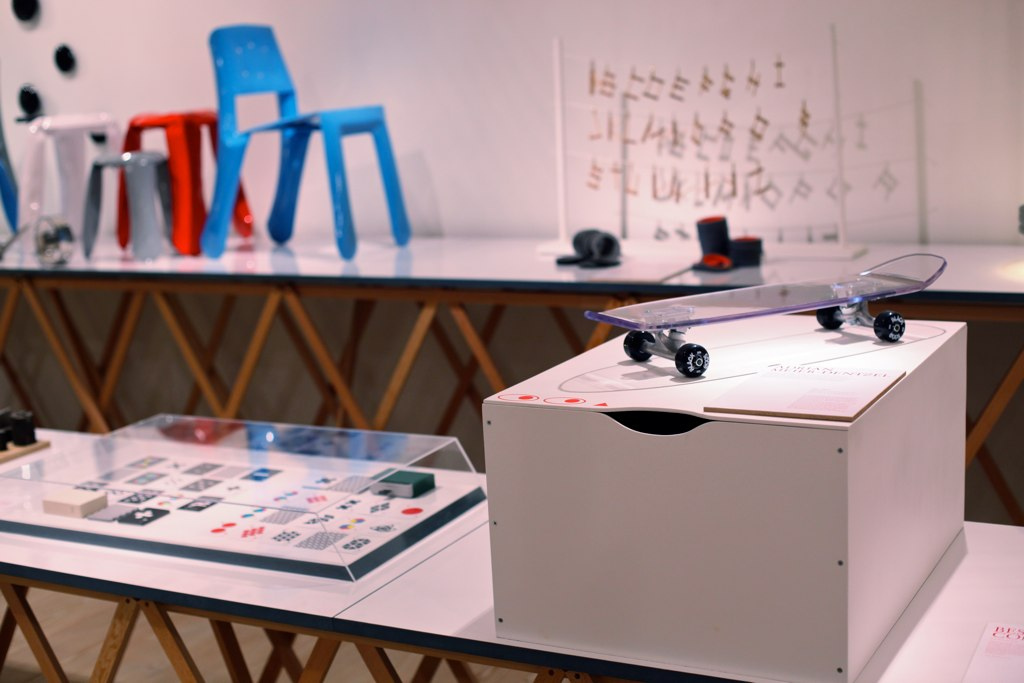
Here are some belated images from the opening in London where the Glass Slipper first met the public, and is still residing.  Brent, the fantastic curator of the Philips De Pury design program, told me that there were over 700 people at the opening for Projectory, which is excellent news.


Brent Dzekciorius, curator, making sure all's in order before the doors open

The diagram means: "look inside the white box and see the glowing crystal"
NOT "deposit fried eggs here"

In good company: Tauba Auerbach's Two Decks of Cards to the left...


...and Best Made Co. axes to the right.

This guy never took his scarf off, which made more sense when I learned that keeping your scarf on at openings is a contractual necessity of being part of the Association of Perennially-Tan European Art Collectors.

Monday, October 4, 2010

I Am There Now

I did an interview on a nice blog called You Have Been Here Sometime.  The questions are good, and I'm happy to be there among the nice interiors and objects. Check it out...


Be sure to look at some older posts on this blog.  There is a whole slough of inspiring material there.

http://youhavebeenheresometime.blogspot.com/

Wednesday, September 15, 2010

Relevant News

Two things, both related: one, I made a website for my design projects; two, I have a piece in a great group show opening next Monday, September 20th at the Phillips de Pury design space at Saatchi Gallery in London.  I honestly feel very lucky to show among such great designers.  You can see which ones below in the official invite, which, I should add, is not exclusive.  If you are in London, please come check it out.  If you want to see something wonderful, watch Max Lamb make a stool on the beach here.

The piece I have in the show is called the Glass Slipper.  It is a clear, transparent, light-up skateboard shaped from a single piece of polycarbonate.  It is a midsize board with many influences.  The outline is based on the Stubbie surfboards designed by George Greenough and currently made by Bob Duncan in Santa Barbara, Ca.  However, the Glass Slipper's outline has no curves but rather a polygonal shape.  The entire edge is chamfered and polished to cater to the light shining from within from LEDs in light-up risers, recessed into the deck.  Polycarbonate is super tough and pretty flexible.  The Glass Slipper is a flex deck, but not a longboard, or a tiny seventies-style fiberglass board.  The feel is fluid,  bouncy, and new. 

I'm very happy to feature Solitary Arts hardware, especially the Moonlights light-up risers.  Many thanks to Yong-ki and Geoff (the Glass Slipper's first test audience) for all the support and for making such fine gear. 

Here are some photos, the invite to the show (I'm listed as Adrian Meier-Dentzel), and the "official" blurb about the Glass Slipper:


Big round of applause please for Brent Dzekciorius, a curator cut from the finest curatorial cloth.  I installed my piece recently, and was very impressed with the depth of knowledge and appreciation Brent has for all the designers and their pieces in the group.  The guy cares.


"Glass Slipper"
skateboard, 2010
Adrian Rubi-Dentzel
polycarbonate, LEDs, metal, pulyurethane

The product of nostalgic futurism and California lore, the Glass Slipper is a crystal clear, glowing skateboard.  During the day, watch the prism-flecked sidewalk pass under you.  At night, glide down the street on an illuminated crystal slab.

Each Glass Slipper is hand-shaped out of a single piece of clear polycarbonate by Adrian Rubi-Dentzel at UFACTO in Paris, France, and features Moonlights light-up risers, Black Eggs wheels, and Steely Shieldless bearings, all by Solitary Arts, and "22" trucks by Ace.

On show and available at Phillips de Pury at Saatchi Gallery in London.

Friday, June 25, 2010

Thumb Buddy

Back in the 50's and 60's, Fender basses had a whole slough of accoutrements that somehow fell by the wayside and do not appear on basses made in the last 20 years or so.  One of those things is a thumb rest. These days, most people just use the side of the pickup or don't use anything.  The problem with that is, if you want to hit the string in the sweet spot just below of the end of the neck, there's nothing there for your li'l thumb to perch on.  So today, I finally got around to making a little thumb perch for my admittedly not-super-old Jazz Bass.  I used a piece of Iroko left over from some bedstands (still need to post those) and some nice looking brass screws.  I'm not thoroughly educated on Iroko, but I do know that it is tropical, has nicely pronounced grain, and smells kind of like clove cigarettes when you cut it.

Monday, May 3, 2010

Weird Things

When I go to Marfa, Texas, I make weird things.  I show up at my little adobe house, unload my tools, and dive into my lumber collection.  I have brought to Marfa old redwood panels from my wife's childhood home, doors, windows, plywood, 2x4s, etc. from California.  Now I have a nice little clutch of materials to choose from when I need to make a weird thing.  What is a weird thing?  A weird thing is a piece of furniture that addresses a specific need in the house, made of lumber I have on site, and built in under an hour using nothing more than a skilsaw and an electric drill/driver. (There may or may not have been a router, planer, or sander used on some of them, but mostly its the drill and saw).  It is all certifiable Chop 'N' Screw Domestic Solutions.  Weird Things:


 Extra weird thing.  So weird Danielle had to paint it white to tone it down a little.  That horse head is an unfinished half scale carousel animal.  I come from a long line of carousel builders; my great great grand uncle brought the first carousel to the USA (more here).   Sometimes I have to save things from the burn pile at my grandma's house, like wooden horse heads.  Weird.

Saturday, May 1, 2010

My First Sony

This is the first custom piece I did in Paris.  It is a wall mounted box closet for Imelda and Francesca, two wonderful people.  When I made this, I tested and proved to myself that in small apartments, big furniture feels significantly less imposing if you lift it off the ground.  I have since mounted a few more things to the walls of Parisian apartments (coming soon to this blog).  This room also houses a couple pieces by Nathaniel Russell.  Good company, all around.

Thursday, April 29, 2010

Light Green Leaves

Life triumphs over long distance travel!
I brought a couple of sprouted acorns back to France (smuggled in my toiletries bag) from my mother's backyard in Santa Barbara, Ca.  I think they're Valley Oaks, but I'll have to double check (I know the tree from which they fell, and as the saying goes, it was not far). The original leaves withered as the trauma set in. Then, after some time in the sun in some fresh, moist soil and many encouraging words, a pair of soft, fresh, spiny leaves unfurled.

Wednesday, April 28, 2010

Bou!

There is a new show up at Galerie Kreo in Paris showing new works by Ronan and Erwan Bouroullec.  I did a lot of work at UFACTO on prototyping and fabricating the wall mounted lamps and the shelves.  They are both made of molded fiberglass with immense attention paid to the finishes: the lamps are a glossy piano black; the shelves are a grainy, felty, matt charcoal grey.  If you are in Paris go by the gallery and check it out.  I'm very proud to have had a hand in this show.  Not only is Erwan a friend, he is, alongside his brother, one of the most creative and tasteful designers working today.  More here, and here.

Sunday, January 31, 2010

Parabolic Pink

I made a couple of these lamps last week at UFACTO.  Named "Parabola" and designed by Pierre Charpin, these pieces are made at UFACTO for Galerie Kreo.  Kreo represents a smattering of high-level designers, mostly from France, and produces pieces that would usually be impossible to fabricate in a large-volume, industrial manner.  This means that the pieces designed for Kreo are usually both quite large (the Parabola stands about 7.5 feet tall, and requires at least that much free wall space to hang) and quite expensive (six digits, in Euros).  Kreo consistently has these pieces, especially the molded fiberglass ones, made at UFACTO.  Each piece is produced in an edition of 12, and sometimes just 1.

The bell is made of two separate fiberglass shells, glued together at the outer edge and at the center.  Quite flexible when separate, the bell stiffens up considerably when both pieces are fixed to each other.  
You might not be able to tell from the image of the finished lamp, but the bell and the stand are not attached.  Rather, the bell, or shade, is fixed to the wall and the bulb stand is stationed in front of it.   Fun fact: the shade of pink was chosen by Charpin to match a faded t-shirt he was wearing while going over the fabrication with David Toppani (master craftsman of UFACTO).  The rosy reflected light is beautiful in person.

Wednesday, January 27, 2010

Half Pint


I was over at a friend's house the other night for dinner and ended up installing some curtains.  To do the job, I was presented with this charming little chickadee.  I want one.

Monday, November 23, 2009

They All Lived In There


Can someone tell Ringo to move his "ride"?  It's blocking the delivery truck.

Merde


These props are used in water treatment plants in the Ile-de-France region. They are, quite literally, big shit mixers. So, next time you sit down and consider how much you enjoy both the luxuries of modern toilettes and of clean oceans, lakes, rivers, and streams, remember that somewhere, in an anonymous warehouse outside of town, there is a team of highly skilled craftsmen and craftswomen hand moulding precision designed equipment to deal with all that you flush away.

Foam Big, Glass Heavy


For the last few weeks I've been working for UFACTO on an exceptionally large project. So large that it is being built in a workshop about two hours outside of Paris at Poly 2000, a studio that specializes in large, functional fiberglass structures like propellers for the Paris region water treatment facilities, 30+ foot boat hulls, and apparently the odd submarine.

The piece is by Francois Roche, a Paris-based architect, and can best be described as a branchy, apartment-sized, fiberglass asteroid-cave. It is made of polystyrene foam carved mostly by a CNC and by hand in some functionally sensitive zones, wrapped in fiberglass roving and laminated with a special polyester resin that won't dissolve polystyrene foam. It will be painted a glossy white after all the required sanding is done; then it will be shipped in a few containers to Japan where it will stay in sculpture garden. David Toppani carved a slightly smaller one by hand a few years ago for an exibition in France. Quite impressive considering the forms are computer-generated, and quite specific despite the random feel of the form. The above photo is of one of about 17 blocks that fit together to form the final elongated cave which is about the size of a two or three bedroom boxcar apartment with 18 foot ceilings. It will be equipped with a large, flat-screen monitor inside, embedded in a stalactite, and a LED enhanced skylight.


The yellowish color is the filler that gets sprayed over the fiberglass to fill in the fibrous texture before painting. The splotchy green is the fiberglass before the filler is applied. Not very attractive colors at this stage, especially considering the mucousy shape of the thing.   I think the white will improve the overall look of it in the end, but I will probably still think it is not totally my kind of thing. However, I remain thoroughly impressed with the scale and extremity of the design.

Tuesday, October 13, 2009

Corner Pocket


The top-floor, corner window is what I look out of when I'm in my bathroom, mostly when I'm hanging laundry or spying. If there was a second floor balcony, this would be a thoroughly typical Haussmann style building. Maybe because it sits along Rue D'Avron, a significant eastern entry and exit of the city, they held off on the low-floor balcony. As ridiculous as it feels to write the following phrase, here are a couple quotes about the Haussmann style from Wikipedia,

"Neighbouring buildings had to have their floors at the same height, and the façades' main lines had to be the same. The use of quarry stone was mandatory along these avenues. Paris started to acquire the features of an immense palace."

Also from Wikipedia, these are the basic guidelines for the Haussmann facade, floor by floor,

"-ground floor and basement with thick, usually street-lateral, load-bearing walls;
-second, "noble" floor with one or two balconies;
-third and fourth floors in the same style but with less elaborate stonework around the windows;
-fifth floor with a single, continuous, undecorated balcony
-eaves angled at 45º."

There is a lot to criticize about the Haussmann renovations (disrupting the social order, bowing to the wealthy landowners, etc.), but he and Napoleon III (an elected emperor) managed to disinfect, beautify, and rebuild an entire capital city! I try to imagine the mindset with which one sets out on such a project, and it seems like a combination of insanity, megalomania, social responsibility, trepidation, and fearlessness (both of pissing people off, and of biting off more than you can chew).

(Photo by Molly Tuttle.)